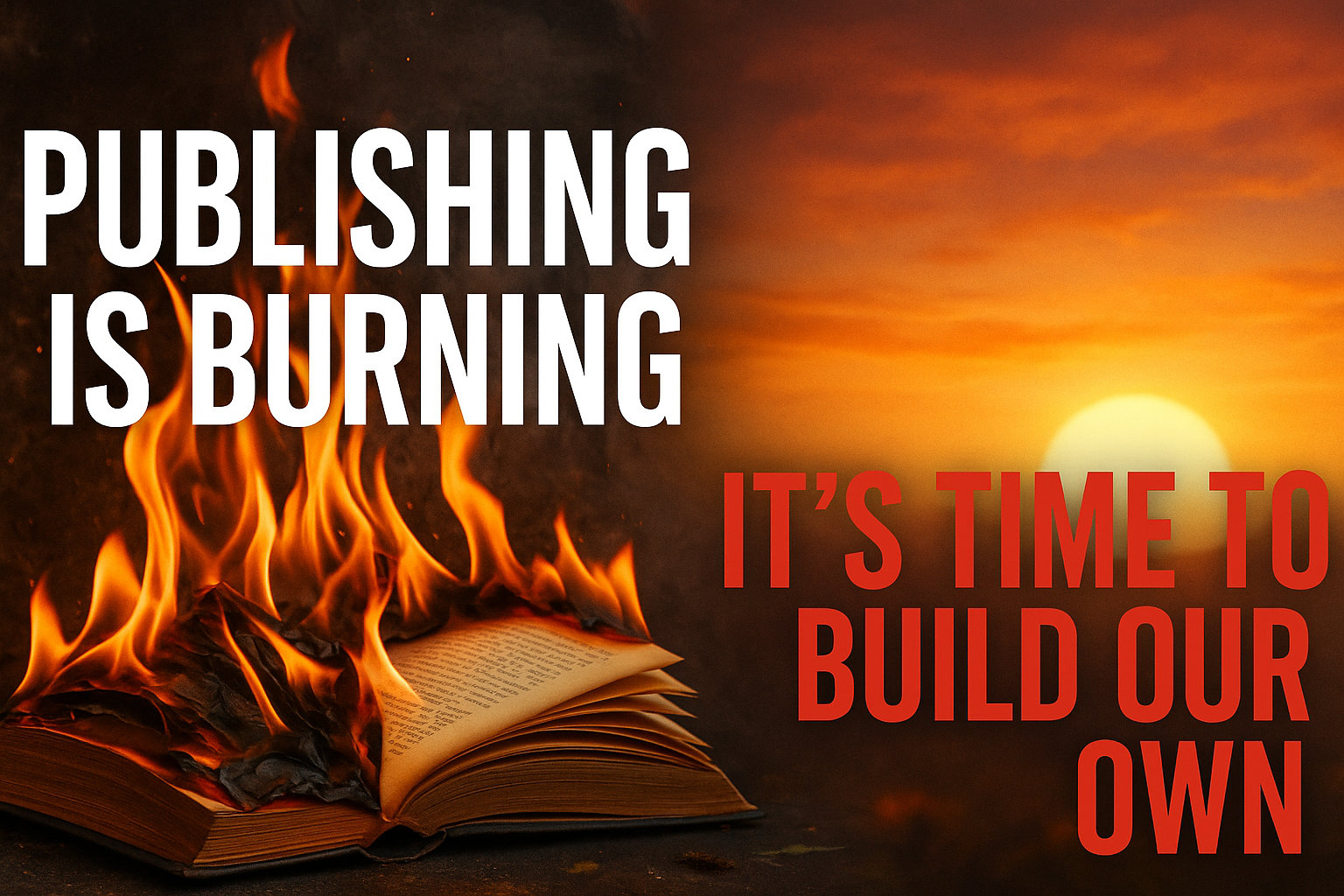

Amid crisis and upheaval, the business of books is on fire — layoffs, canceled imprints, and market shake-ups set pages aflame. Big houses slash editors and shutter divisions, from HarperCollins closing its YA imprint Inkyard Press in 2023 to Penguin Random House pushing out half its senior staff (including Knopf editor Daniel Halpern). Even giants like Amazon flex monopoly muscle – suddenly closing the UK’s Book Depository and crippling small publishers overnight. Public support has been gutted, too: in 2025 the NEA abruptly withdrew dozens of literary grants, terminating 41 of 51 planned awards in its publishing category. As news feeds with gloom, the impulse may be to wait for a white knight. But Black creators and communities are not sitting idle. We’ve been through worse crises and carried our own torches.
Onstage at a New York podium, an African American woman speaks passionately into the mic — a reminder that voices like hers have always led change in publishing. “Take Toni Morrison, once a Random House editor in the early 1970s: she inherited an industry “unbearably white,” where 95% of big-press fiction was by white authors. Morrison used her position to flip the script. “I could make sure there was a published record of those who did march and did put themselves on the line,” she later explained. In practice, that meant championing writers from Muhammad Ali and Angela Davis to Toni Cade Bambara and June Jordan — and editing them unsentimentally, cutting “weak essays” to let Black voices shine. For modern authors, Morrison’s example is clear: when gates close, build new doors. Her strategy of carving out space from within offers a powerful lesson in agency.
Another trailblazer, Charles R. Johnson, saw publishing as part of a broader cultural mission. The National Book Award–winner edited anthologies and journals that amplified African American art and ideas. For example, he guest-edited the Chicago Quarterly Review’s “Anthology of Black American Literature,” a “cornucopia of creativity” featuring 27 Black poets, storytellers, and artists. Johnson shows that writers can be editors, curators, and bridge-builders — roles that turn the politics of gatekeeping on their head. Like Morrison, he proved that Black authors needn’t wait for permission to speak; they can create their own platforms. These pioneers teach us: control the narrative and make community wealth.
When Giants Fall: Layoffs, Imprint Closures, and Corporate Collapse
The headlines read like obituaries for publishing. In 2023, HarperCollins announced a 5% workforce reduction, axing its Harper Design art unit and folding it into other lists. A few months later it shut down Inkyard Press entirely, laying off its five-person team. Penguin Random House offered voluntary buyouts to nearly half its veteran staff; in one week Publishers Weekly reported Knopf editor Daniel Halpern among those exiting. These aren’t isolated blips but systemic cuts. As one industry writer warned, each shuttered imprint and sacked editor “ripples” through the ecosystem: authors lose their champions, agents have fewer submission spots, and remaining editors are overwhelmed by abandoned projects.
Amazon’s grip on books only worsens the squeeze. With virtually unlimited market power, it can flip a switch on a profitable arm at will. In April 2023, Amazon quietly declared The Book Depository – a major global outlet for independent publishers – would simply cease to exist in three weeks. No new owner, no archived platform: countless indie presses and authors had to scramble for alternative sales channels. As one commentator notes, Amazon’s moves leave “no warm words” for displaced workers, and downstream outlets (bookstores, smaller presses) “rely on [its] shuttered operations” for revenue.
As if corporate cutbacks weren’t enough, federal arts support has been slashed. In 2025 the Trump administration moved to zero out NEA funding, and almost immediately terminated hundreds of grants, including most literary arts awards. Local theaters, literary magazines, reading series and writers’ centers awoke to notices of “immediate withdrawals” of funding. Two of every three NEA applications in the 2025 poetry & publishing cycle were cancelled, wiping out vital budgets for book projects, festivals, and fellowships. The NEA used to fund ~$200 million a year; that well is drying up just as private media conglomerates retreat from meaningful investment in literature.
Together, these forces are hollowing the old publishing model. Conglomerates consolidate; bookstores shrink (remember Barnes & Noble’s past bankruptcies); and gatekeepers tighten their grip. In the Black community, the sting is especially sharp: even at Random House under Morrison, Black editors were “practically nonexistent”, and today only ~11% of titles from major US houses are by Black authors. The numbers barely budged over decades. In 1971, Morrison noted 95% of fiction was white-authored; by 2018 it was still 89%.
The Rise of the Underdogs: Independent and Self-Publishing
If the system won’t let us in, we leap over the wall. Black writers today are turning to grassroots presses and self-driven launches as survival tactics. The legacy is rich: in the 1960s and ‘70s, the Black Arts Movement sparked its own “independent press revolution.” Dudley Randall’s Broadside Press (founded 1965) became “one of the most influential black presses” of that era, publishing Gwendolyn Brooks, Audre Lorde, Sonia Sanchez, Haki Madhubuti and others when mainstream wouldn’t. Around the same time Chicago’s Third World Press (1967) carried Haki Madhubuti’s vision to life, creating a long-lived Afrocentric publishing house still active today. These legacy presses embraced self-pride and cultural anger, forging Black literary freedom from the ground up.
Today’s independent voices echo that legacy. Ntozake Shange, for instance, cut her teeth in the feminist small-press world. Her first novel Sassafrass, Cypress & Indigo (1982) built on earlier poetry self-releases – Shange’s Sassafrass was first printed by Berkeley’s tiny Shameless Hussy Press in 1977. Instead of waiting for a big contract, Shange crafted her own route onto shelves. The result: decades later she’s hailed as a master of verse and narrative.
In a different vein, Teri Woods rewrote the rulebook for urban fiction. Rejected by 20 mainstream publishers over six years, the Philadelphia lawyer-wife didn’t blink. In 1998 she printed and bound True to the Game herself, selling novels hand-to-hand and out of her car. Within three years she was a self-made millionaire, her grassroots hustle having reinvigorated the market. Woods even started her own imprint (Teri Woods Publishing), giving life to sequels and spin-offs that trad houses had dismissed. Her story shows how sheer perseverance can create a movement: readers and retailers flocked to her street-lit vision when the gatekeepers turned away.
Sister Souljah’s breakthrough similarly proved there’s a hungry audience beyond Big Five marketing spreadsheets. In 1999 she leveraged her hip-hop fame into The Coldest Winter Ever, an instant classic of urban fiction published by a major house — but only after Souljah built enough buzz on her own. And when she parted with that publisher in the 2000s, Souljah continued releasing work through grassroots means and her record company, showing that authenticity can sustain a writing career even amid industry blacklists.
These examples illustrate a hard truth: the road for Black writers often runs outside Main Street’s fancy boulevards. Self-publishing and indie presses remain vital escape routes. The lessons are clear: control your narrative, master the tools of production (social media marketing, small-run printing, e-book platforms), and lean on community networks. As one urban lit editor puts it, Woods and Souljah “reignited” a market by simply refusing to take “no” for an answer.
Historical Context: Gatekeeping and Black Literary Sovereignty
Why are we battling so hard now? Decades of erasure and exclusion set the stage. In a 2023 piece, Dan Sinykin noted that in 1971 “about 95 percent of the fiction published by the big commercial houses was by white authors,” and by 2018 it had only crept down to 89%. Black staffers like Morrison were anomalies at white-run companies. The so-called “diversity” progress has largely stalled. Gatekeepers have long dictated which stories get told — and too often they came from one social class or color.
During the Black Arts Movement, frustrated writers took matters into their own hands. The Broadside Press championed Black voices of self-pride and protest; artists published plays and essays in church basements and on street corners; and poetry micro-presses sprung up in Detroit, Chicago, Oakland and elsewhere. That foundation of self-publishing and collective organizing is our inheritance. When mainstream channels are shuttered today, we remember those trailblazers. Their message was simple: to build culture, you sometimes have to build the press.
Standing Our Ground: A Call to Cultural Sovereignty
We face a publishing landscape designed to shrink and squeeze, but the only way out is through our own power. This is a moment of rupture and possibility. We choose independence over waiting, creativity over collapse, and mutual aid over rescue fantasies. Our stories are too precious to be gatekept or defunded. As Toni Morrison reminds us, sometimes “you need to free somebody else” – and that “somebody” can be the author who follows you.
The industry may be burning, but we’re building our own fire – one fueled by roots and wings. With every self-published chapbook, every community reading, and every solidarity-strike, we stitch a new house of words. The behemoths can fall away, but culture endures. Let this crisis sharpen Your focus: you have the creativity, control, and community to write your own future.
Leave a Reply